Why Multi-Page Documents Break Every Other Solution
Single-page documents are easy.
That’s why most tools look great in demos.
But real workflows? They run on multi-page documents.
And that’s exactly where traditional extraction breaks.
Most systems still process documents one page at a time.
That might work for simple files.
But multi-page documents aren’t a stack of pages – they’re one connected source of truth.
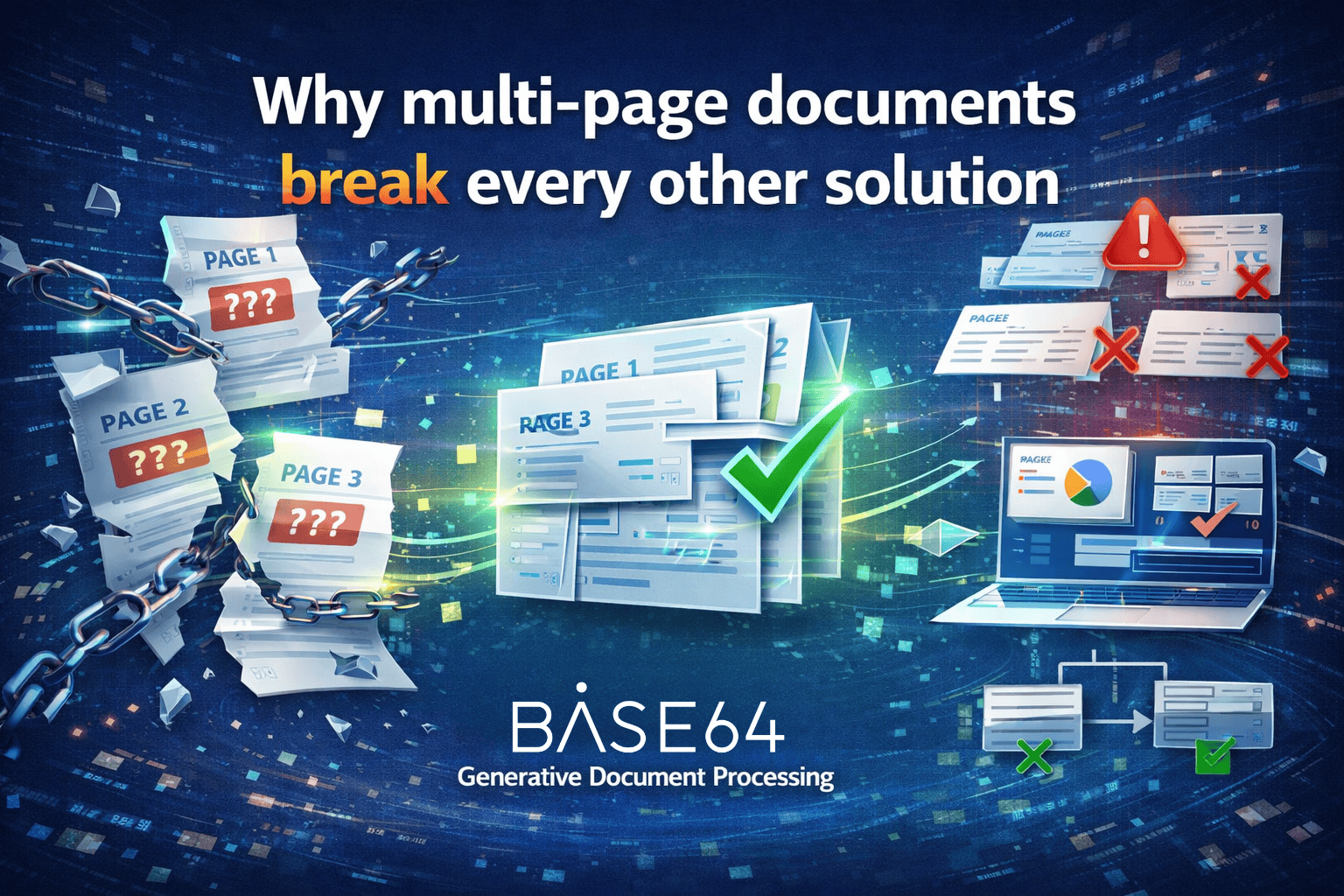
Here’s what goes wrong with legacy approaches:
Context disappears
Key information is spread across pages – headers, totals, line items.
Page-by-page extraction loses the relationships between them.
Tables fall apart
Tables don’t stop at page boundaries.
But most systems do breaking rows, misaligning columns, and corrupting data.
Duplicates and inconsistencies creep in
Repeated headers and footers get extracted multiple times.
Totals don’t match. Records don’t reconcile.
No document-level understanding
At the end of the day, these systems don’t understand documents – they just read pages.
This is exactly what Base64 fixes
Base64 processes documents the way they’re meant to be understood:
as complete, multi-page entities – not isolated pages.
That means:
- Context is preserved across the entire document
- Tables stay intact – even across page breaks
- Data is extracted once, correctly, and consistently
- Outputs are clean, structured, and ready to use
No stitching. No post-processing. No manual fixes.
Built for real-world documents
Invoices. Bank statements. Medical records. Contracts.
These aren’t edge cases – they’re the norm.
And they’re almost always multi-page.
Base64 is designed to handle that complexity out of the box, so your team doesn’t have to.
The result
Instead of debugging broken extractions, you get:
- Reliable, document-level JSON
- End-to-end consistency
- Automation that actually works in production
Most tools work on perfect, single-page examples.
Base64 works on real documents.