Why Bankruptcy Document Processing Is Becoming an AI Priority for Banks
Bankruptcy workflows have always been document-heavy. But as filing volumes fluctuate and operational teams face increasing pressure to move faster, many banks are realizing that traditional processing methods are becoming difficult to scale efficiently. From petitions and schedules to proof of claims, notices, payment histories, and court filings, bankruptcy operations involve large amounts of highly variable documentation that often requires manual review and data entry.
For many institutions, these workflows still depend heavily on human processing.
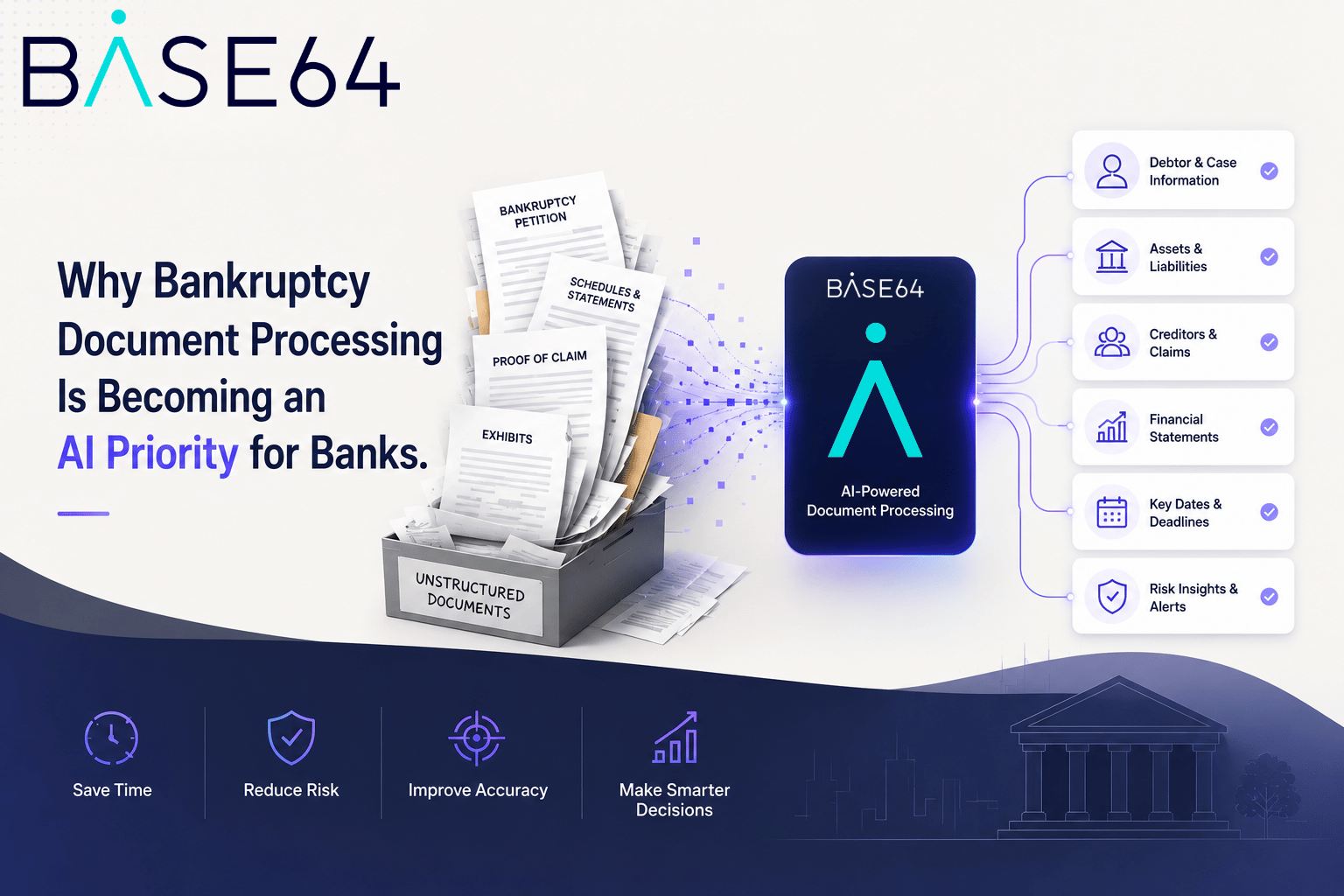
Teams manually extract case details, validate debtor information, review filing updates, classify incoming documents, and transfer data between systems. The process is time-consuming, operationally expensive, and difficult to standardize at scale, especially when documents arrive in inconsistent formats from different courts, trustees, law firms, and servicing platforms. This is where AI-powered document processing is beginning to create significant operational value.
Unlike traditional OCR systems that focus primarily on text recognition, modern AI platforms can understand document context and structure. This allows banks to automate much more than simple extraction.
AI can automatically:
- classify bankruptcy-related documents
- identify case information and debtor details
- extract key financial data
- recognize filing updates and status changes
- validate extracted information
- route exceptions for human review
This becomes especially important in bankruptcy operations because documents are rarely standardized. Layouts vary widely across jurisdictions, courts, and filing types, making template-based approaches difficult to maintain long term.
AI-driven systems are better equipped to handle this variability without requiring constant manual configuration or template updates. Operationally, the impact can be significant. By reducing repetitive document handling and manual indexing work, banks can improve processing speed, reduce backlog, minimize data entry errors, and allow operations teams to focus on higher-value exception handling and case management tasks.
Another major advantage is scalability. During periods of increased filing activity, operational teams often struggle to keep pace with rising document volumes. Intelligent automation helps institutions process larger workloads more efficiently without needing to scale headcount at the same rate.
As financial institutions continue modernizing operations, bankruptcy processing is becoming one of the clearest examples of where AI can drive measurable operational efficiency gains while improving consistency across highly complex workflows.
At Base64.ai, we help banks transform bankruptcy operations from a manual, document-heavy burden into a streamlined, AI-powered workflow that scales with confidence.