What Slows Banks Down?
Banks invest heavily in technology to improve efficiency, reduce risk, and deliver better customer experiences. Yet despite these investments, many critical processes still depend on one thing: how quickly information can move through the organization.
Every day, financial institutions receive thousands of documents that support onboarding, lending, compliance, servicing, fraud investigations, and countless other workflows. Bank statements, tax forms, pay stubs, IDs, business registrations, financial statements, court records, and bankruptcy filings all contain information that drives important decisions. However, before those decisions can be made, someone must access, review, validate, and process the data contained within those documents.
This is where time begins to accumulate.
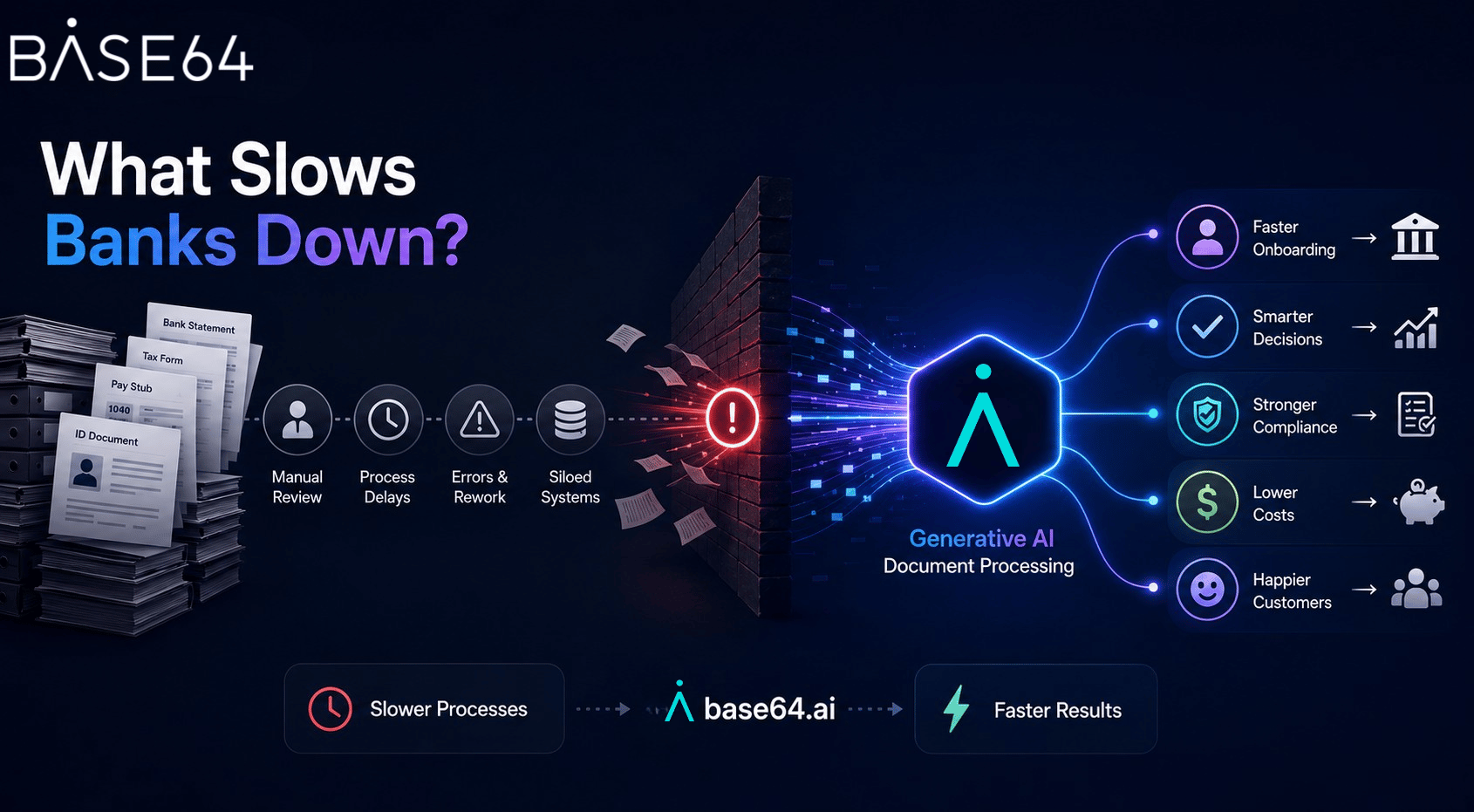
Today’s customers expect rapid responses and seamless digital experiences. Businesses expect faster lending decisions. Regulators expect accurate and timely compliance processes. Internal teams are expected to do more with the same resources. In every case, the ability to access and act on information quickly has become a competitive advantage. This is why document intelligence has become such an important part of digital transformation strategies.
Base64.ai enables financial institutions to automatically classify, extract, and validate data from virtually any document type through a single platform. Instead of relying on employees to manually review documents and transfer information between systems, organizations can convert unstructured documents into structured, actionable data in seconds. Whether processing customer onboarding documents, supporting lending decisions, reviewing tax forms, analyzing financial statements, or handling complex legal and compliance documentation, teams gain immediate access to the information they need without the delays associated with manual processing. The impact extends beyond operational efficiency. Faster access to data leads to faster decisions. Faster decisions improve customer experiences. Better customer experiences drive growth, loyalty, and competitive differentiation. In an industry where customer expectations continue to rise and operational efficiency is increasingly important, reducing delays is no longer just an operational objective. It is a strategic priority.
Because in banking, every minute matters. And the institutions that can transform documents into usable data the fastest will be the institutions best positioned to compete in the future.