We’ve Entered the Post-Template Era
For over a decade, templates defined Intelligent Document Processing. You set the layout, mapped the fields, locked in the coordinates – and hoped the document wouldn’t change. For a time, that worked.
But enterprise documents don’t stand still. Vendors update formats. Regulations add new fields. Customers submit variations. Global expansion introduces new languages and structures. What was once predictable is now constantly shifting.
In this environment, template dependency has become operational drag. Maintenance replaces momentum. Every change requires rework.
We’ve entered the post-template era – and this shift isn’t cosmetic. It’s architectural.
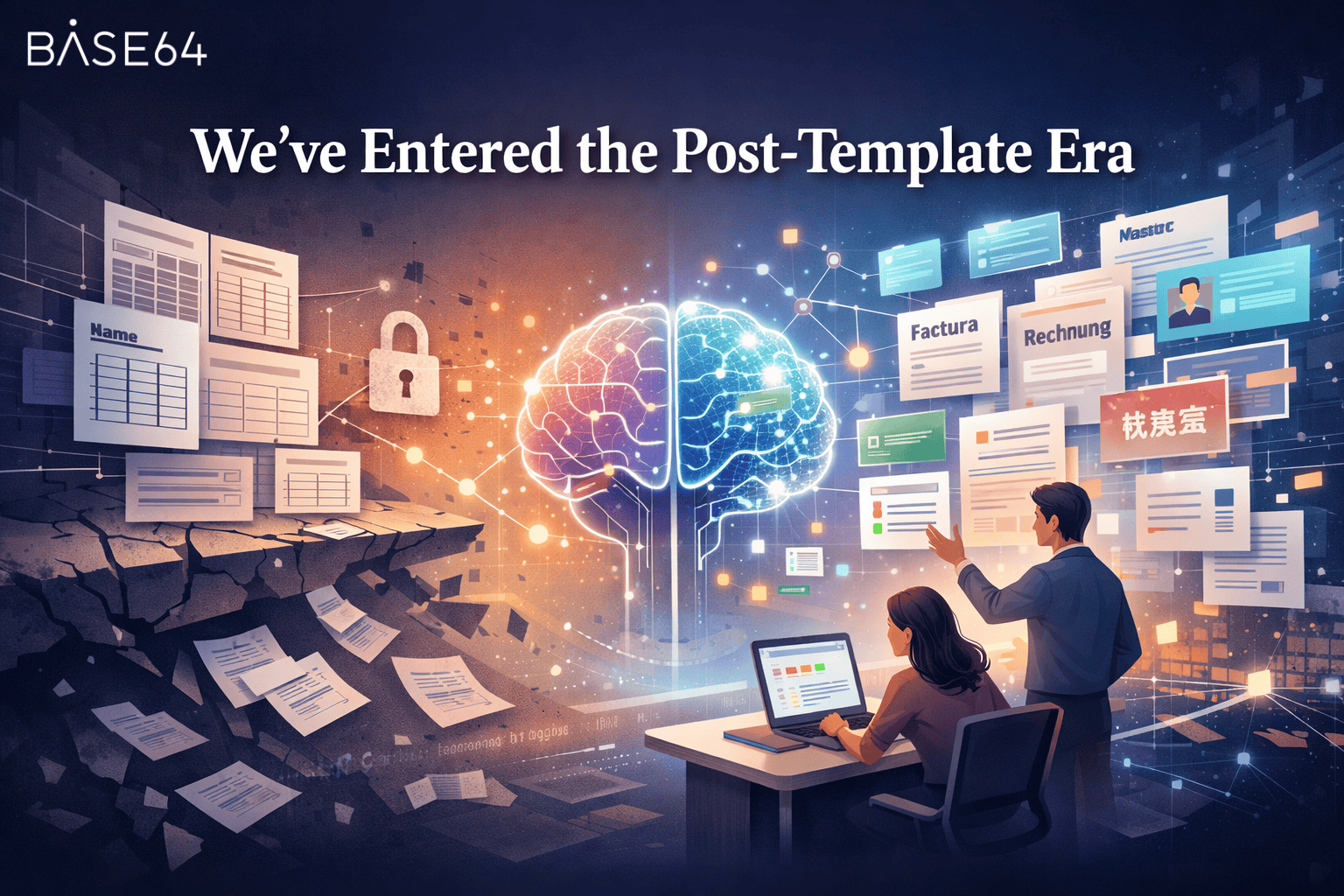
The first generation of IDP digitized documents.
The second automated structured extraction.
The emerging generation understands context, adapts dynamically, and reasons across documents.
That changes what’s possible at the executive level.
Instead of asking:
“How many templates do we need to maintain?”
Leaders can ask:
“How quickly can we operationalize new document flows?”
Instead of worrying about format drift,
they focus on decision velocity.
The competitive advantage no longer comes from extraction accuracy alone.
It comes from adaptability.
Modern enterprises need document infrastructure that:
- • Handles unseen document types without configuration
• Adapts to layout shifts automatically
• Understands relationships across pages and packets
• Explains decisions in audit-ready language
• Integrates directly into operational workflows
Templates were a workaround for technical limitations.
GenAI-native systems remove the limitation itself.
At Base64.ai, we built for variability from day one – no rigid template libraries, no brittle rule dependencies and no reconfiguration every time reality shifts.
Because the future of document intelligence isn’t about managing structure.
It’s about building systems that understand meaning.
And in the post-template era, adaptability isn’t a feature.
It’s the foundation.