The Foundation of Every Successful AI Strategy
Artificial intelligence is evolving faster than ever. Technologies like Agentic AI, Retrieval-Augmented Generation (RAG), and Model Context Protocol (MCP) are redefining how financial institutions automate operations, improve decision-making, and deliver better customer experiences. But despite the excitement around these innovations, one fundamental question remains:
Can your AI access the information it needs to make the right decisions?
AI Is Only as Good as the Data Behind It
No matter how advanced an AI model becomes, it cannot deliver meaningful business outcomes without reliable, structured data. For banks, that data is everywhere.
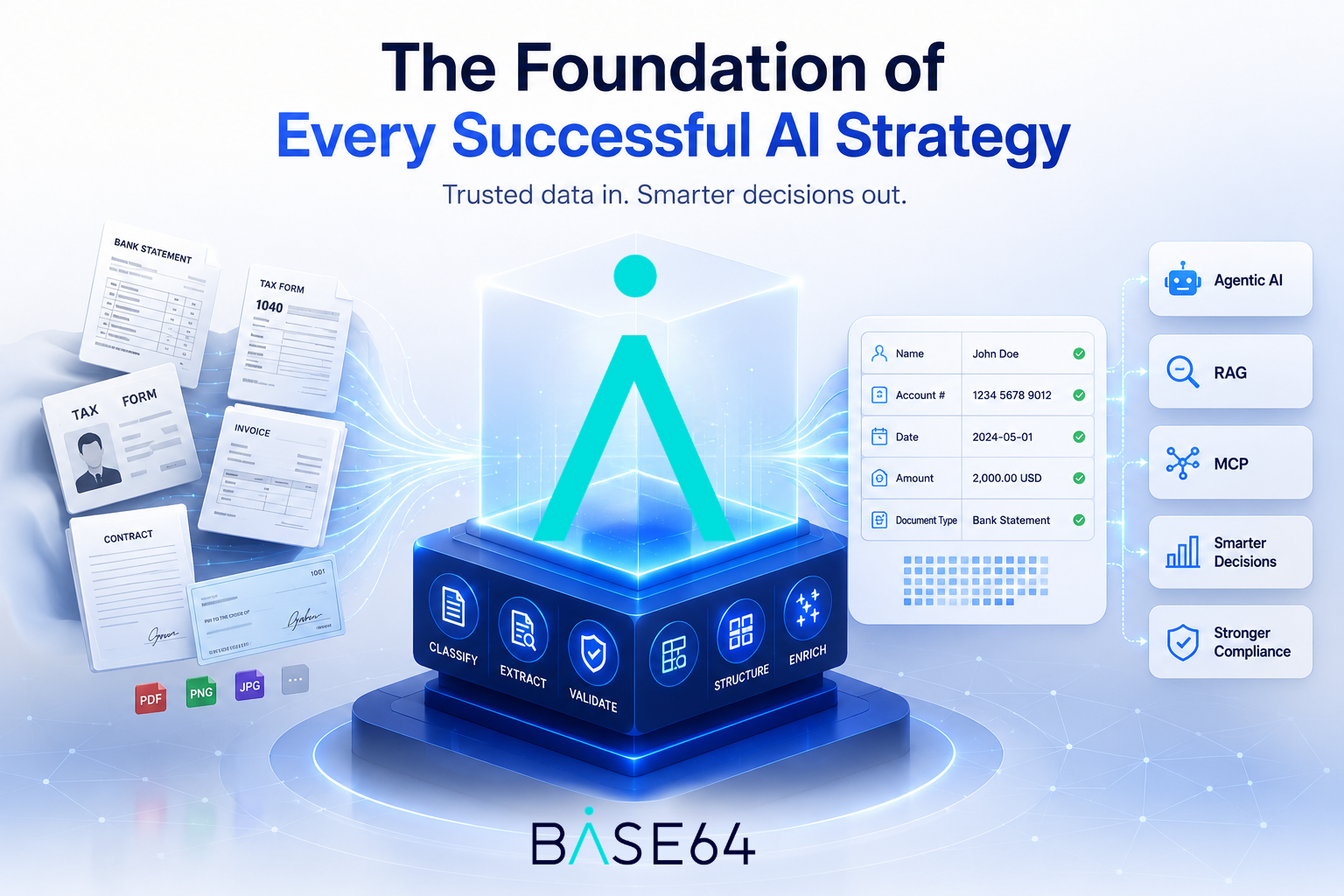
Customer IDs. Bank statements. Tax forms. Business registrations. Financial statements. Bankruptcy filings. Checks. Court records. Every one of these documents contains critical information that supports onboarding, lending, fraud detection, compliance, and countless other banking operations. The challenge is that much of this information remains trapped inside PDFs, scanned documents, and images.
Before AI can automate a workflow, the data inside those documents must first become accessible.
Emerging AI Technologies Need a Strong Foundation
Agentic AI can execute multi-step workflows autonomously.
RAG improves AI accuracy by retrieving trusted enterprise information before generating responses. MCP simplifies how AI connects with existing business systems and applications. These technologies are changing what’s possible, but they all rely on the same prerequisite: Trusted, structured data. Without it, AI becomes another tool waiting for information.
Turning Documents into Intelligence
This is where document intelligence becomes essential.
Base64 enables financial institutions to automatically classify documents, extract structured data, validate key information, and deliver clean, actionable data directly into existing systems. Whether processing IDs, bank statements, tax forms, checks, business registrations, bankruptcy filings, or financial statements, the platform provides a single foundation for virtually every document-driven workflow. Instead of implementing separate solutions for different document types, banks can standardize document processing across the organization while preparing for the next generation of AI.
Preparing for What’s Next
The conversation is no longer about whether banks should adopt AI.
It’s about how quickly they can scale it. Organizations that invest in a strong document intelligence foundation today will be better positioned to adopt Agentic AI, RAG, MCP, and whatever comes next, without rebuilding workflows every time technology evolves. The future of AI won’t be defined by who has the most advanced model. It will be defined by who has the best data.
Because every successful AI strategy starts with the same foundation: trusted, structured information.