The Cost of Waiting: Why Enterprises That Delay Document Automation Will Fall Behind
For years, document processing has been viewed as an operational problem. Something to optimize later. Something that belongs to IT. Something employees can simply “work around.” That mindset is becoming expensive.
Today, organizations aren’t competing only on products or pricing. They’re competing on speed. How quickly can you onboard a customer? How fast can you process a loan? How long does it take to approve an insurance claim? How quickly can compliance teams respond to an audit? Every one of these answers depends on one thing: How fast information moves through your business.
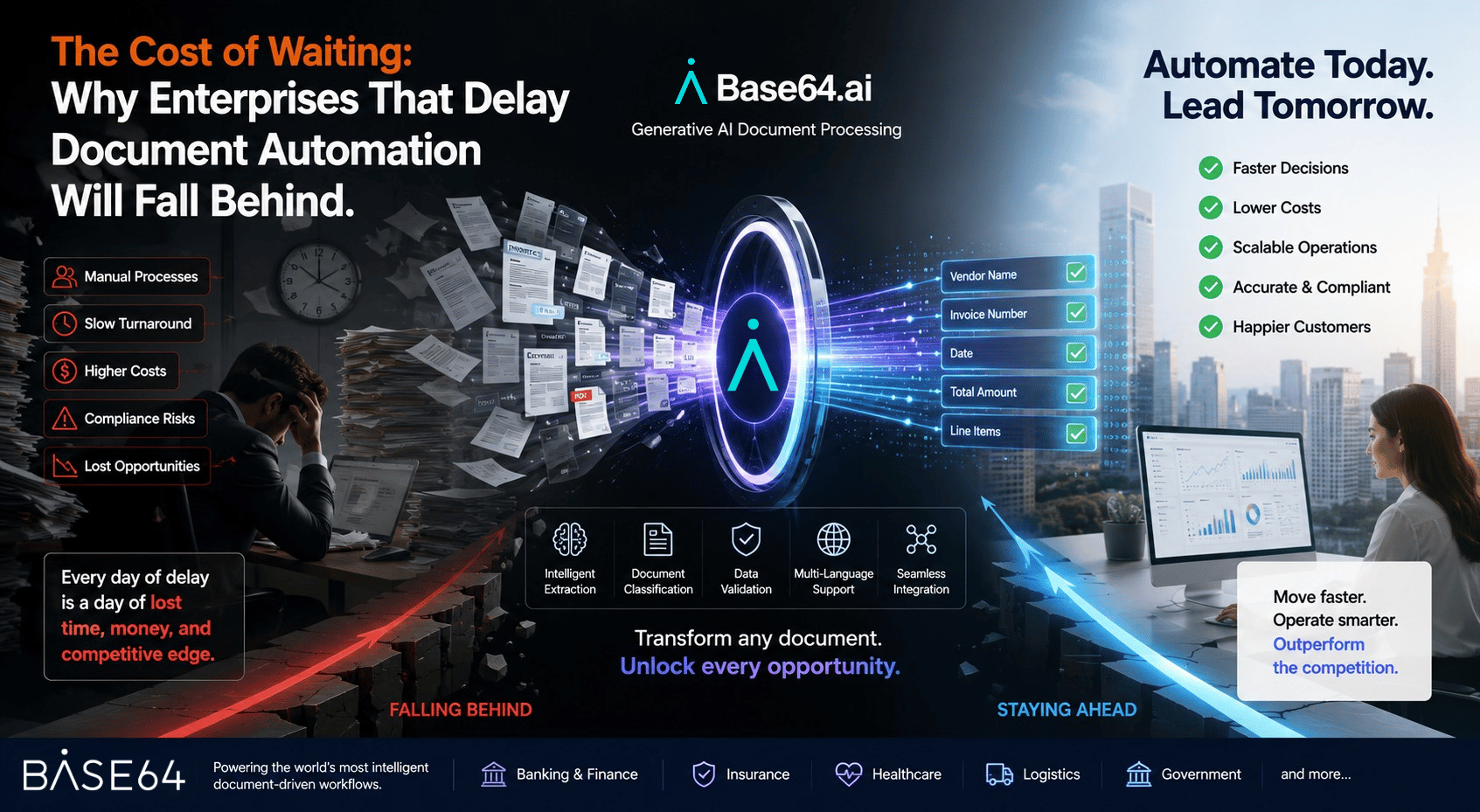
Manual Work Doesn’t Scale
Many organizations have invested heavily in digital transformation, yet their most critical workflows still rely on people opening PDFs, copying information into systems, validating fields, and routing documents manually. It isn’t because teams want to work this way. It’s because documents have remained one of the hardest problems to automate. As business volumes grow, these manual processes become more expensive, harder to manage, and increasingly difficult to justify. Adding more employees isn’t a long-term strategy. Neither is expecting teams to work faster.
The Hidden Cost Isn’t Labor
Most companies calculate the cost of manual document processing by looking at employee hours. That’s only part of the picture.
The real costs are harder to measure:
- Customers waiting longer for decisions.
- Revenue delayed because onboarding takes days instead of minutes.
- Compliance risks caused by manual reviews.
- Operational bottlenecks that prevent teams from scaling.
- AI initiatives that fail because critical data never becomes structured.
Every delayed document creates a chain reaction throughout the organization.
Why Leading Organizations Are Automating Now
The conversation has changed. Document automation is no longer just about reducing costs. It’s about increasing capacity. Organizations that automate document processing can handle significantly more business without proportionally increasing headcount. They move faster, respond to customers sooner, and free employees to focus on decisions instead of data entry. That creates an advantage that compounds over time.
Why Base64.ai?
At Base64, we help organizations eliminate one of the biggest bottlenecks in enterprise operations: extracting reliable data from virtually any document. Our platform can process thousands of document types across more than 165 languages, automatically classify incoming files, extract structured data, validate information, and integrate directly with your existing systems. Whether you’re processing financial documents, insurance forms, government records, identity documents, contracts, invoices, or complex document packages, Base64.ai helps transform hours of manual work into automated workflows. The result isn’t just faster document processing.
It’s faster business.
The Organizations That Move First Will Set the Pace
Every organization is trying to become more efficient. The difference is that some are still talking about automation, while others are already building it into every workflow.
The gap between those two groups will only continue to grow. The question isn’t whether document automation will become a necessity. The question is whether your organization will adopt it before your competitors do.
If your teams are still spending valuable time extracting information from documents manually, it’s time to rethink what’s possible.
Learn how Base64.ai can help you automate document processing, accelerate decision-making, and prepare your organization for the next generation of intelligent operations.