REAL ID Is Here But Airports Aren’t Fully Ready
The rollout of REAL ID is finally here! While it’s a major step forward for security, it’s also putting new pressure on airports and airlines in ways that aren’t always obvious at first glance.
Every additional ID check, every moment of hesitation at a checkpoint, every manual verification step adds up. What used to be a quick visual inspection is now a stricter, more consequential process. And when that process happens thousands of times a day, even small inefficiencies start to create real bottlenecks.
For airports, that means longer lines and increased strain on staff. For airlines, it means tighter boarding timelines and a higher risk of delays. And for passengers, it often translates into a more stressful travel experience.
The challenge isn’t REAL ID itself – it’s the fact that most identity verification workflows still rely heavily on manual inspection.
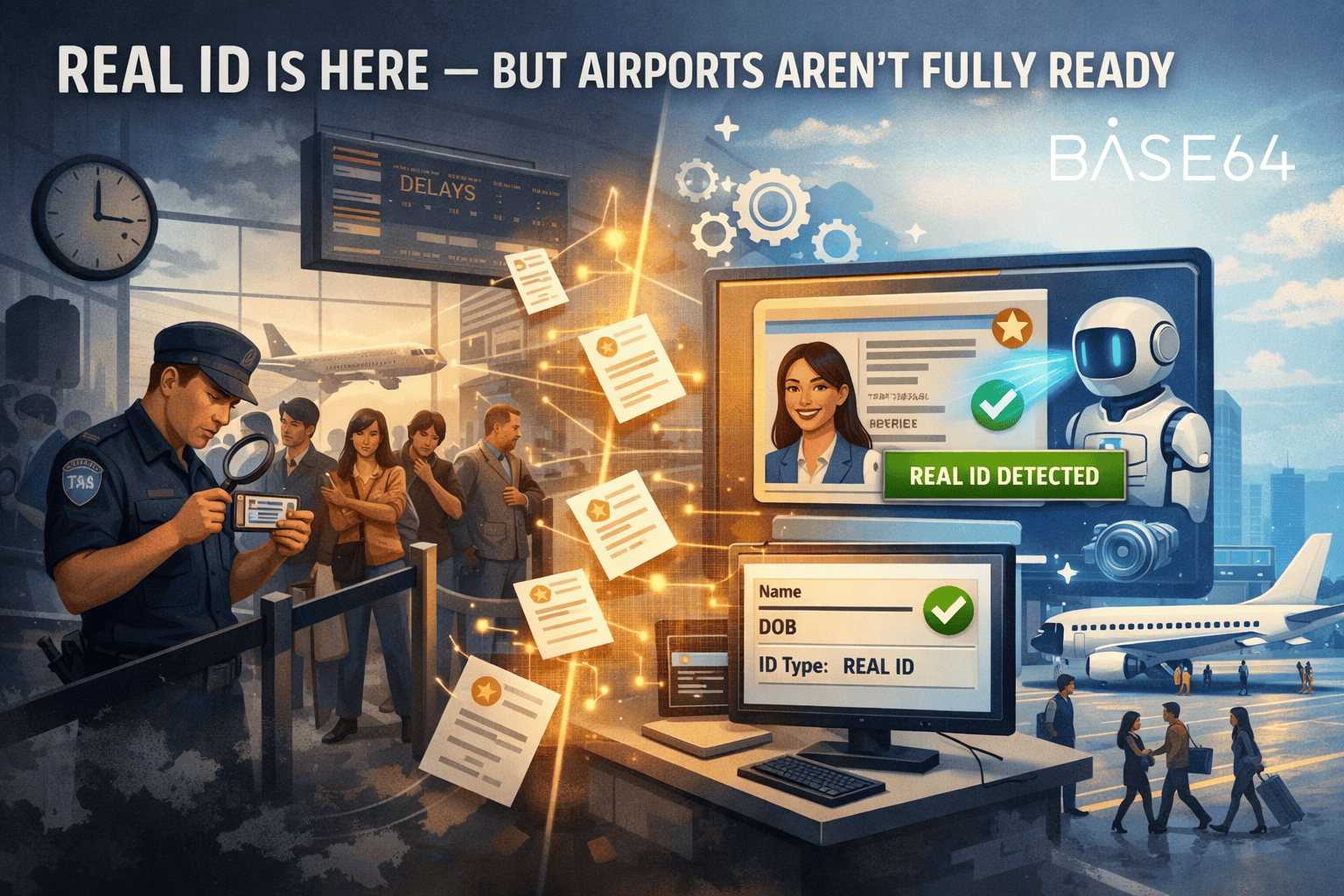
At Base64.ai, we’ve been focused on solving exactly this problem. We were recently awarded a U.S. patent for technology that uses AI to automatically detect REAL ID and Enhanced ID indicators on identification documents.
Instead of relying on a human to visually confirm whether an ID is compliant, AI can analyze the document image and quickly and consistently identify key visual markers, such as symbols indicating REAL ID or Enhanced ID status.
What this enables is a more streamlined verification process. IDs can be checked faster, with greater consistency, and without adding additional burden on staff. In high-throughput environments like airports, even small improvements in speed and reliability can have a meaningful impact on overall operations.
For airports and airlines, this creates an opportunity to rethink how identity verification fits into the passenger journey – not as a bottleneck, but as a seamless, automated step that supports both compliance and efficiency.
What makes this especially impactful is that it’s not a standalone feature – it’s part of a broader document AI platform built to handle IDs end-to-end. From extracting data to identifying document types and now automatically detecting REAL ID compliance, everything works together in one system. For airports and airlines, that means faster, more reliable verification without adding complexity – exactly what’s needed as volume and requirements continue to increase.