One Platform. Every Document.
Banks process an enormous variety of documents every day. Driver’s licenses. Passports. Bank statements. Tax forms. Pay stubs. Financial statements. Business registrations. Loan applications. Court records. Bankruptcy filings. Each document contains valuable information needed to support onboarding, lending, compliance, servicing, fraud prevention, and countless other banking processes. Yet many financial institutions still rely on multiple tools to process these documents. One solution for identity verification. Another for bank statements. A separate workflow for tax documents. Manual review for complex files that don’t fit neatly into existing systems. Over time, this creates operational complexity.
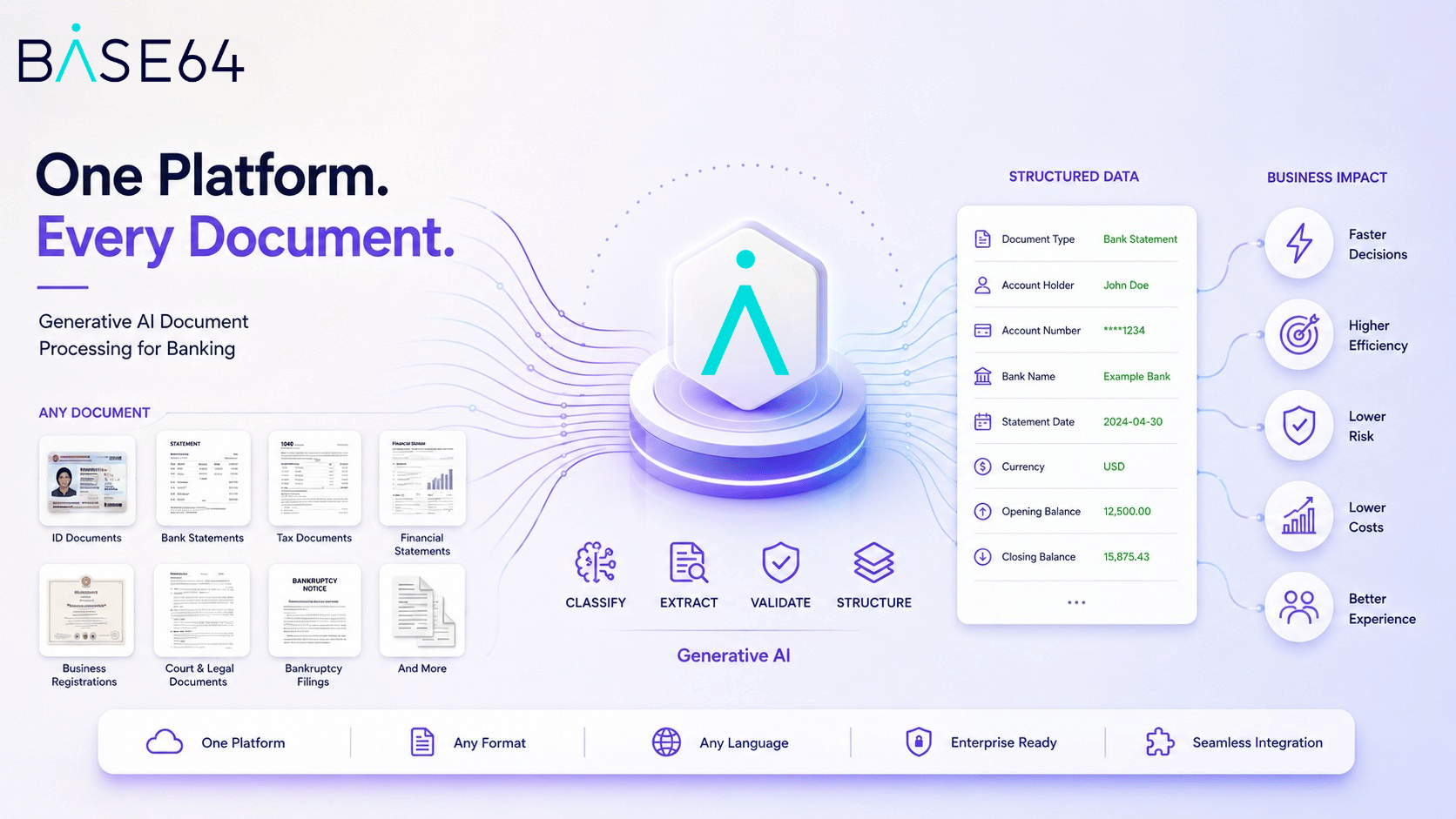
Teams are forced to manage multiple vendors, integrations, workflows, and exceptions. New document types require additional development effort. Processes become fragmented. And valuable information remains trapped inside documents that are difficult to automate. The reality is that banks don’t have a document problem.
They have a document diversity problem.
Customers, businesses, and partners submit documents in countless formats, layouts, languages, and quality levels. A modern document processing strategy needs to be able to handle all of them, not just a select few. That’s why more financial institutions are moving toward a unified approach. Instead of deploying separate solutions for different document types, leading organizations are adopting platforms capable of understanding and extracting data from virtually any document through a single system. The answer isn’t another document processing tool. It’s a platform capable of handling every document that enters the bank.
Base64.ai enables financial institutions to classify, extract, and validate data from virtually any document type through a single platform. Whether it’s a driver’s license, passport, bank statement, tax return, financial statement, utility bill, business registration, bankruptcy filing, or court document, organizations can automate document processing without adding new systems, templates, or operational complexity. The result is a simpler technology stack, reduced manual review, faster processing times, and greater operational efficiency across the organization.
Most importantly, banks gain the flexibility to automate new document types as business needs evolve, without introducing additional tools or complexity.
The future of document processing isn’t about adding more solutions.
It’s about having one platform that can handle every document.
One platform. Every document.