Data Extraction Is the Foundation of Modern Business Automation
Every organization wants to automate more. Whether it’s accelerating customer onboarding, streamlining accounts payable, improving compliance, or deploying AI-powered workflows, the goal is the same: move information faster, reduce manual work, and make better decisions. But there’s one challenge nearly every organization shares.
Most business data is still trapped inside documents.
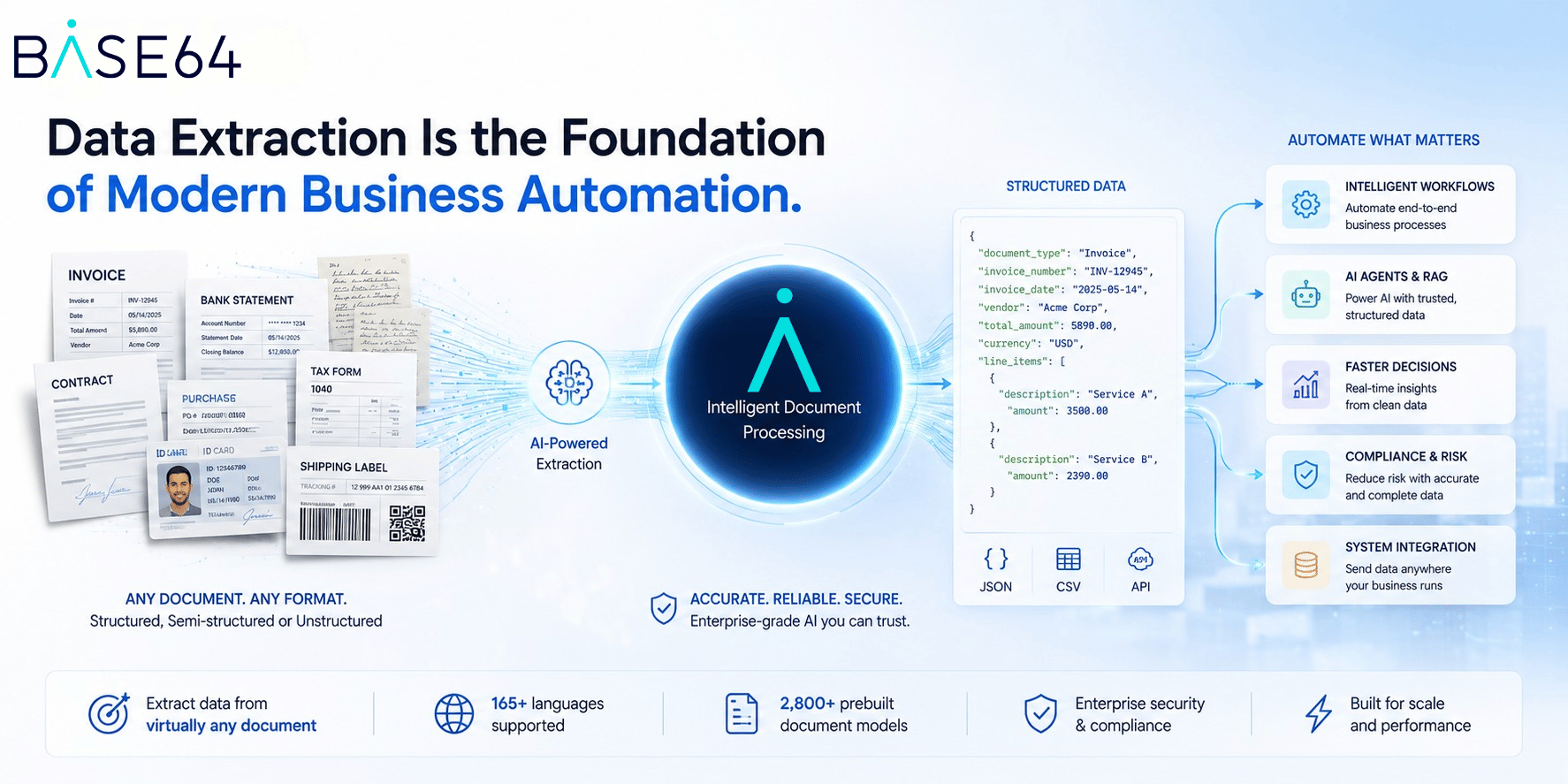
Documents Are Everywhere
Businesses process thousands, even millions of documents every year. Invoices. Bank statements. Tax forms. Contracts. IDs. Insurance claims. Bankruptcy filings. Purchase orders. Bills of lading. Utility bills. Financial statements. These documents contain the information organizations rely on every day. Yet much of that information remains locked away in PDFs, scanned images, emails, and paper forms. Before a business can automate a process, someone often has to manually read those documents and enter the data into another system. It’s slow, expensive, and prone to human error.
Data Is More Valuable Than the Document
Organizations don’t process documents because they need more PDFs.
They process documents because they need the information inside them.
A bank doesn’t approve a loan based on a PDF, it evaluates income, assets, liabilities, and credit history. An insurance company doesn’t process a claim because it received a form, it needs policy details, claim information, and supporting evidence.
An accounts payable team doesn’t care about an invoice image, it needs vendor information, invoice numbers, dates, totals, and payment terms. The document is simply the container. The data is what drives the business.
Why Traditional OCR Falls Short
For years, OCR helped organizations digitize documents by converting images into text. While that was an important first step, today’s businesses need much more than text. They need systems that understand documents. Modern data extraction identifies key fields, captures tables, recognizes handwritten content, validates information, classifies document types, and delivers structured data that business applications can immediately use. Instead of simply reading documents, organizations need technology that understands them.
Data Extraction Powers Modern AI
As organizations adopt Generative AI, AI agents, and intelligent workflow automation, the quality of their data becomes increasingly important. AI can summarize documents, answer questions, and automate decisions, but only if it has access to accurate, structured information. That’s why data extraction has become one of the most important building blocks of enterprise AI. Without it, organizations are asking AI to interpret inconsistent, unstructured documents on the fly. With it, AI works from trusted, validated data that is ready to drive business processes.
From Documents to Decisions
At Base64.ai, we believe data extraction should be seamless.
Our platform extracts data from virtually any document, whether it’s structured, semi-structured, or completely unstructured, and transforms it into clean, structured JSON that integrates directly with your existing systems. With support for 2,800+ prebuilt document models, 165+ languages, and a wide range of document types, organizations can automate document-heavy workflows without relying on templates or lengthy model training. Whether you’re processing financial documents, identity documents, insurance forms, shipping paperwork, government records, or legal filings, Base64.ai helps eliminate manual data entry and accelerate every downstream process.
The Future Starts with Better Data
Organizations often focus on the latest AI model or automation platform, but the greatest opportunity lies much earlier in the workflow. It starts with capturing the right information. When data flows automatically from documents into your business systems, teams spend less time on repetitive work, processes move faster, compliance improves, and AI delivers better outcomes. The future of automation isn’t about processing more documents. It’s about unlocking the data inside them.
That’s where modern data extraction makes all the difference.