Base64 Featured in Dynamic Business’s 2026 IDP Guide
We’re pleased to share that Base64 has been featured in Dynamic Business’s “Tech Tuesday: The complete guide to intelligent document processing tools in 2026.”
The guide explores solutions that help businesses turn unstructured documents into structured, actionable data, a challenge at the heart of what we do. For organizations handling large volumes of documents, that challenge goes well beyond reading text. Information needs to be classified, extracted, checked, and delivered to the right system before anyone can act on it. Each manual step can add delays, introduce inconsistencies, and take employees away from work that requires their expertise.
At Base64, we help teams connect those steps and build more efficient document workflows.
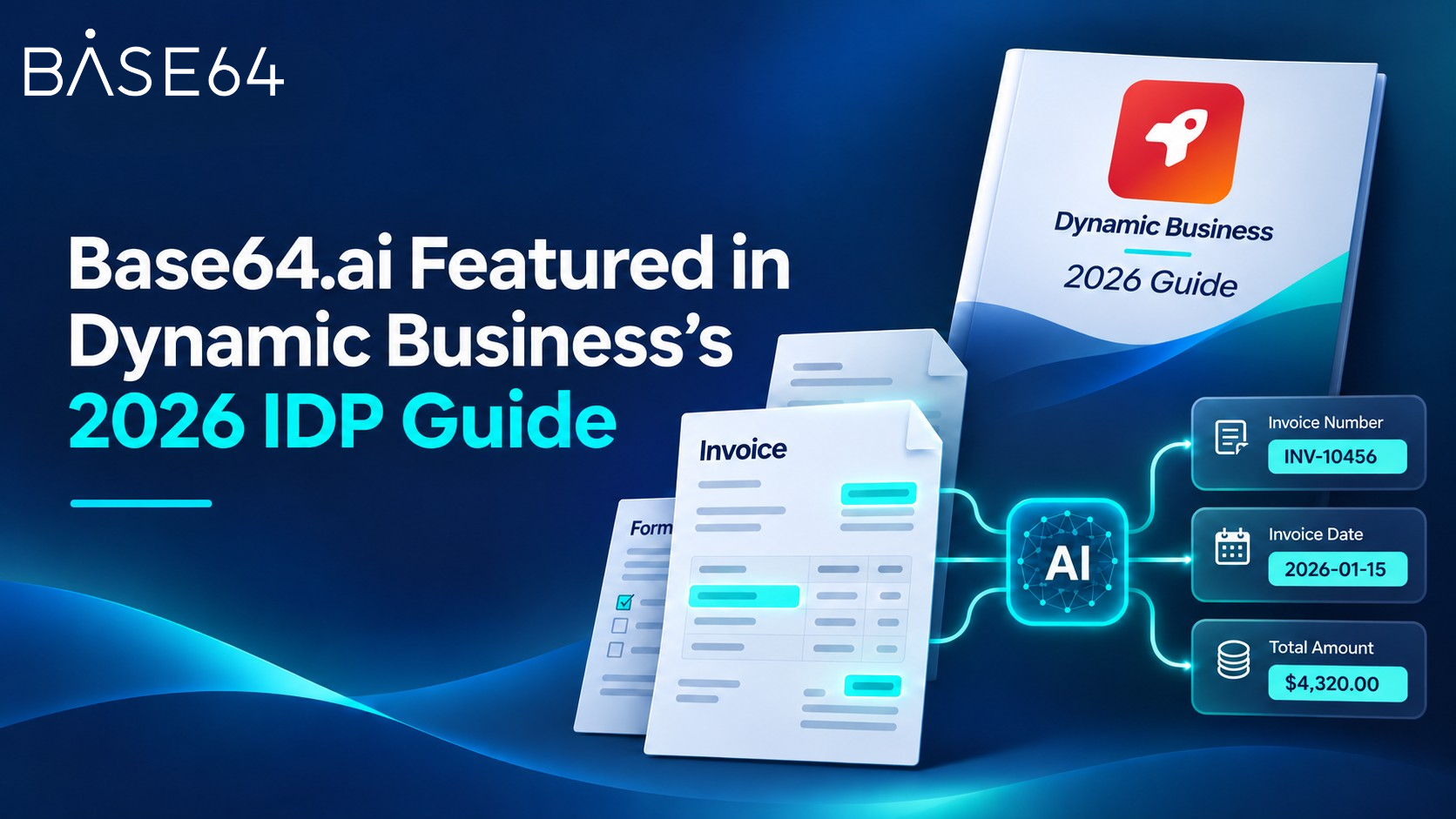
Turning documents into usable business data
Essential information arrives in many formats: invoices, forms, IDs, PDFs, scanned documents, and more. Even documents serving the same purpose can vary in layout, language, and structure, making manual processing difficult to scale. Base64 brings together document classification, data extraction, validation, and workflow automation to help organizations manage that variety. With 3,000+ prebuilt models, custom model capabilities, and hundreds of integrations, teams can process documents and connect the extracted information to their existing business systems. Our Flows builder helps bring those capabilities together into workflows that reflect how each organization operates.
Moving beyond extraction
Capturing a field is one part of the process. Teams also need to understand where the information came from, standardize it for downstream systems, and determine what should happen next. An invoice may need additional review before payment. An onboarding document may be missing required information. A field may need to follow a specific business rule before it can move forward. Base64 helps teams address these needs within their document workflows. Data transparency connects extracted information to its source, while post-processing and custom taxonomies help prepare results for use across other systems. The goal is practical: reduce repetitive work and help people act on document data with greater confidence.
Building on the knowledge teams already have
Employees often know exactly how a recurring document should be handled. The opportunity is to make that knowledge reusable. With capabilities such as Teach AI, teams can turn repeated corrections and business instructions into rules for future documents. Instead of addressing the same issue each time it appears, they can use their experience to improve the workflow over time. This is central to our approach: giving organizations tools to adapt document automation to their requirements as those requirements evolve.
Thank you, Dynamic Business
We’re happy to see Base64 included in Dynamic Business’s guide and to be part of the broader conversation about intelligent document processing in 2026. Our focus remains on helping organizations turn document-heavy processes into connected workflows that save time, support employees, and make information easier to use.
Read the full article on Dynamic Business →
Interested in exploring what this could look like for your team? Schedule a conversation with us.